This is a great snapshot of mobile devices usage at UW--I believe the stats are campus-wide, not just in the library.
If you go to the library.uncc.edu URL on your smartphone, you'll see that we've got the beginnings of a mobile site. In thinking about developing the new mobile site, we need to think about library things that people are likely to do on their phone (as opposed to on their laptop, in person, etc). That means knowing the sorts of things that people already do on their phones (or tablets).
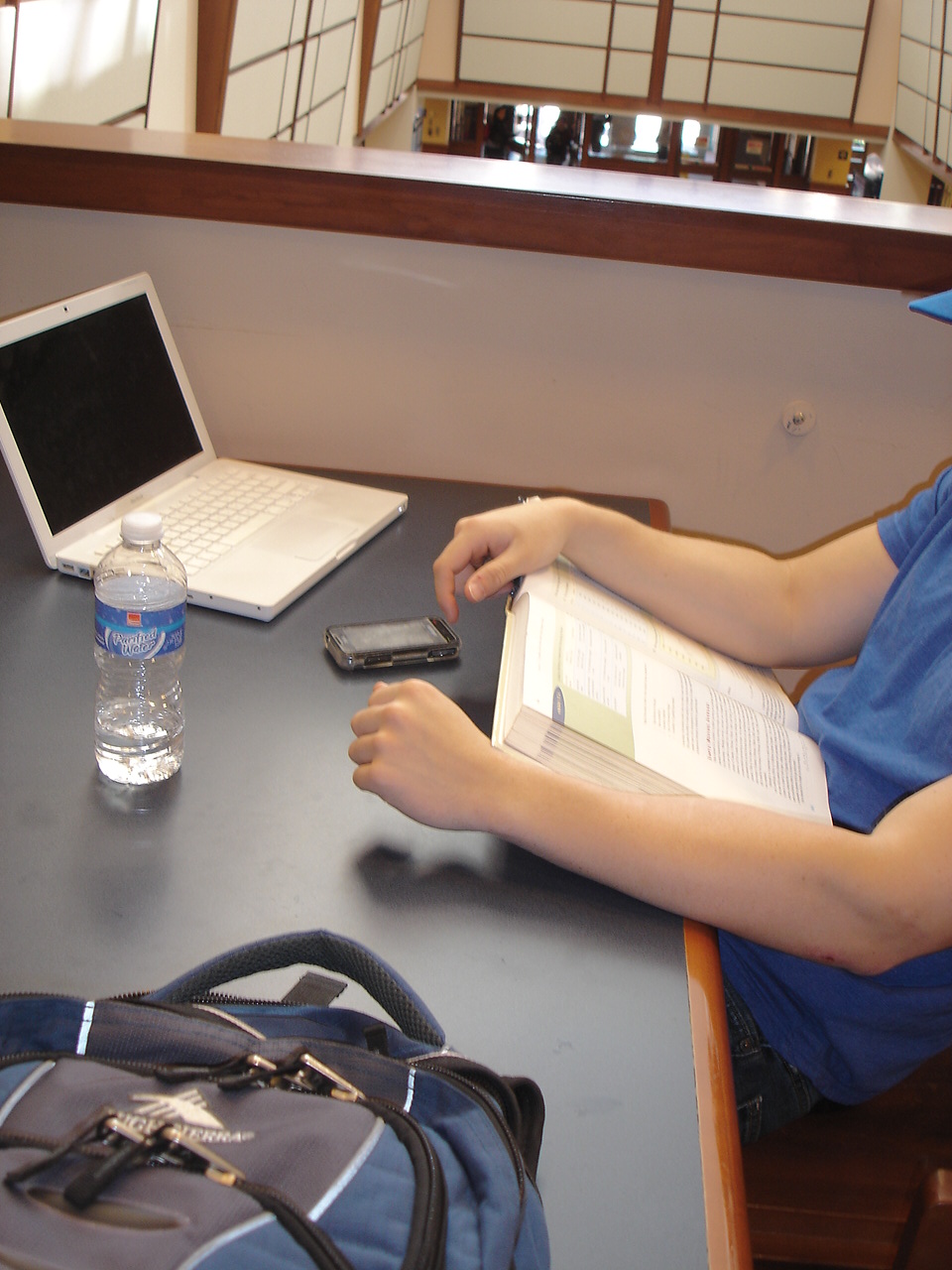
I see tablets and smartphones (as well as laptops and regular cell phones) as a part of student workspaces in the library all of the time.
Like this:
Do you use your smartphone to Google things? What kinds of things? What kinds of work do you do on your tablet (iPad, or other)? Is it different from work you do on other kinds of computers (laptops, desktops)? Are you Macs or PCs, and what difference does that make in the kinds of work you can do in the library and/or with library digital resources?
Tuesday, April 26, 2011
An Anthropologist in the Libraries of LA
No, not me. No field trips for me, yet.
But I was sent this link to a great interview of the new head of the Library Foundation in LA--this gentleman is a trained anthropologist who did fieldwork in the Amazon, as well as many other non-library related jobs (among them, running the Sundance Institute, and while he did that, starting the documentary division of that film institute).
He clearly sees the LA libraries as community resources, not just (as if they ever were) dusty book repositories. He describes libraries as "21st century spaces."
So do we, here at Atkins. More and more of our collections are digital, in part because that is one of the best and most effective ways we can increase our patron access to world-class collections. In thinking about space, we are thinking about the work you need to do, which includes the need to use books but also includes computers, digital materials, and eventually, information formatted in ways we haven't even imagined yet.
What does your library mean to you? Is Atkins "your library?" Or is it the public library back home? Or in your neighborhood here in Charlotte? Where are you when you are "in the library?" Are you here in the building? Or at home, "in" our website?
But I was sent this link to a great interview of the new head of the Library Foundation in LA--this gentleman is a trained anthropologist who did fieldwork in the Amazon, as well as many other non-library related jobs (among them, running the Sundance Institute, and while he did that, starting the documentary division of that film institute).
He clearly sees the LA libraries as community resources, not just (as if they ever were) dusty book repositories. He describes libraries as "21st century spaces."
So do we, here at Atkins. More and more of our collections are digital, in part because that is one of the best and most effective ways we can increase our patron access to world-class collections. In thinking about space, we are thinking about the work you need to do, which includes the need to use books but also includes computers, digital materials, and eventually, information formatted in ways we haven't even imagined yet.
What does your library mean to you? Is Atkins "your library?" Or is it the public library back home? Or in your neighborhood here in Charlotte? Where are you when you are "in the library?" Are you here in the building? Or at home, "in" our website?
Friday, April 22, 2011
Zombie Library!!
Alright, this graphic novel approach to library orientation is fantastic.
Who's going to write one for Atkins?? Anyone??
Tuesday, April 12, 2011
A Google A Day--Trivia Questions to help investigate how people use google to search for information
So Google has a self-described "anthropologist of search," and his blog describes his new "A Google a Day" trivia game.
The game itself appears to be the point of much of the coverage--although at least one journalist sees the game as a potential search tool in and of itself. Hardly anyone points out that what this game will actually do is allow Google to gather information on how people do search. (this is not a secret--Google says that's what they're doing) I wonder if they will share with the rest of us what they learn, or just plow their knowledge back into Google. I wonder if we could ever do something similar with the way that people search for information in our library.
People who know far more about search technology than I do doubtless have much to say about Google's efforts. What do you think about their using a trivia game to gather information?
The game itself appears to be the point of much of the coverage--although at least one journalist sees the game as a potential search tool in and of itself. Hardly anyone points out that what this game will actually do is allow Google to gather information on how people do search. (this is not a secret--Google says that's what they're doing) I wonder if they will share with the rest of us what they learn, or just plow their knowledge back into Google. I wonder if we could ever do something similar with the way that people search for information in our library.
People who know far more about search technology than I do doubtless have much to say about Google's efforts. What do you think about their using a trivia game to gather information?
Wednesday, April 6, 2011
A North Entrance??
Yep, it's true. We're getting a New Entrance to Atkins. It will be on the North Side of the building, facing the Prospector, Burson, Smith, and the CHHS buildings.
This will mean big changes for the ground floor space--there will be more of it, for one thing. What are the sorts of things that you want or need to do when you enter the library? What sorts of things do you need to do after you enter? What kinds of things do you need just before you leave?
What do you think that should mean, in terms of what we put in that space?
Let us know.
The easels are up again! And if you don't write on them (or post in the comments below, or email me, or talk to someone at the Info desk....) we can't know what you're thinking about this.
So, get writing!
This will mean big changes for the ground floor space--there will be more of it, for one thing. What are the sorts of things that you want or need to do when you enter the library? What sorts of things do you need to do after you enter? What kinds of things do you need just before you leave?
What do you think that should mean, in terms of what we put in that space?
Let us know.
The easels are up again! And if you don't write on them (or post in the comments below, or email me, or talk to someone at the Info desk....) we can't know what you're thinking about this.
So, get writing!
Wednesday, March 23, 2011
New Stuff, and New Stuff Coming Soon (edited)
The Atkins website has been tweaked again, and includes a New Books widget that is a fun way for you to browse some of what's new on our shelves.
We'd like to hear from you about other fun and useful things you'd like to have on our website. What about a new way to deal with group study room reservations? What would you like to see in a mobile app for library resources? How could we build QR codes into the mix?
Maybe you have been wishing for something that's none of those things on the list.
Please send in your ideas, and we will have a vote for the top three. Those three items will be sent to our programmers, and they will make the call about whether or not we can make your dreams a reality! Prizes will go to the people whose ideas end up being turned into actual programming.
Even if the ideas you send us are not programmable, they will tell us a lot about what you want from our website, and we always need to know that.
We'd like to hear from you about other fun and useful things you'd like to have on our website. What about a new way to deal with group study room reservations? What would you like to see in a mobile app for library resources? How could we build QR codes into the mix?
Maybe you have been wishing for something that's none of those things on the list.
Please send in your ideas, and we will have a vote for the top three. Those three items will be sent to our programmers, and they will make the call about whether or not we can make your dreams a reality! Prizes will go to the people whose ideas end up being turned into actual programming.
Even if the ideas you send us are not programmable, they will tell us a lot about what you want from our website, and we always need to know that.
Thursday, February 17, 2011
The meaning of "library," and thinking about privacy
This job gives me endless opportunities to observe and hear about the different meanings that people assign to libraries.
I was recently thinking about this when at the public library (the University City branch). So many of us come to university libraries straight from our experiences at school and public libraries. Public libraries are places that, to my mind, are coded as private, domestic, homey spaces, much like public schools. They are places where we assume we will be safe (or should be safe, which is why assaults at libraries and schools are so jarring). They are places that are an extension of our homes--they are places where we can be taken care of, learn things, make mistakes and still be OK. Libraries are where we go if we don't have a desktop computer at home, or if ours is not working. They are where we go for books about gardening (to help with our gardens), cooking (to help us eat well), and an array of fiction, DVDs, and music CDs (to help us when we are bored). Our experiences with public libraries are personal ones. Perhaps this is why public librarians are so fiercely protective of their patrons' privacy, in terms of what they borrow. The assumption is that people check things out of the library because they need that information in their everyday lives. A book about bomb-making, checked out at a public library, can mean something very particular, something personally sinister, because of the private connotations of the space.
University librarians are just as fierce in their protection of patron records as public librarians--the entire profession sees patron privacy as a crucial part of how they do their jobs.
It is NC State Law that libraries have the right to refuse to share patron records, except for in very specific circumstances. The law is as follows:
I was recently thinking about this when at the public library (the University City branch). So many of us come to university libraries straight from our experiences at school and public libraries. Public libraries are places that, to my mind, are coded as private, domestic, homey spaces, much like public schools. They are places where we assume we will be safe (or should be safe, which is why assaults at libraries and schools are so jarring). They are places that are an extension of our homes--they are places where we can be taken care of, learn things, make mistakes and still be OK. Libraries are where we go if we don't have a desktop computer at home, or if ours is not working. They are where we go for books about gardening (to help with our gardens), cooking (to help us eat well), and an array of fiction, DVDs, and music CDs (to help us when we are bored). Our experiences with public libraries are personal ones. Perhaps this is why public librarians are so fiercely protective of their patrons' privacy, in terms of what they borrow. The assumption is that people check things out of the library because they need that information in their everyday lives. A book about bomb-making, checked out at a public library, can mean something very particular, something personally sinister, because of the private connotations of the space.
University librarians are just as fierce in their protection of patron records as public librarians--the entire profession sees patron privacy as a crucial part of how they do their jobs.
It is NC State Law that libraries have the right to refuse to share patron records, except for in very specific circumstances. The law is as follows:
North Carolina General Statutes § 125-19, Confidentiality of library user records
(a) Disclosure. -- A library shall not disclose any library record that identifies a person as having requested or obtained specific materials, information, or services, or as otherwise having used the library, except as provided for in subsection (b).
(b) Exceptions. -- Library records may be disclosed in the following instances:
(1) When necessary for the reasonable operation of the library;
(2) Upon written consent of the user; or
(3) Pursuant to subpoena, court order, or where otherwise required by law.
It is traditional for most library catalog systems NOT to keep patron borrowing histories on file. That way, even if authorities come in with a subpoena, there is nothing to share. Patron privacy is provided by default, in the lack of history-keeping.
University libraries are professional spaces, places where people do the work of scholarship. If someone checks out a book on bomb-making, it's more than likely because of a research project, and the connotaitions of that act of borrowing are less sinister than they would be at a public library. The function of the university library transforms patron attitudes (somewhat) towards privacy--if the university library knows more about borrowing/viewing habits of its patrons, it can actually better serve those patrons by directing them towards materials that they are likely to find interesting/useful. Some of our patrons have actually asked for us to direct them, within the catalog, to resources that they might find useful (much in the way Amazon suggests things based on your purchasing and viewing histories).
If we were to do this, we would have to keep patron viewing/borrowing history somewhere on our servers. Should we ever be served with a subpoena, we would have materials that we would then have to hand over. So our patrons would have to choose, between more targeted, Amazon-style recommendations from the library catalog system and absolute privacy.
I wonder which one you would choose?
Subscribe to:
Posts (Atom)