Wednesday, January 19, 2011

Academically Adrift? More like, Liberal Arts Rule!

Arum and Roksa's book Academically Adrift:  Limited Learning on College Campuses is getting lots of press these days, and the links are flying fast and furious among my colleagues who work both in and out of college classrooms. 
Inside Higher Ed summarizes in bullet points:

"
  • 45 percent of students "did not demonstrate any significant improvement in learning" during the first two years of college.
  • 36 percent of students "did not demonstrate any significant improvement in learning" over four years of college.
  • Those students who do show improvements tend to show only modest improvements. Students improved on average only 0.18 standard deviations over the first two years of college and 0.47 over four years. What this means is that a student who entered college in the 50th percentile of students in his or her cohort would move up to the 68th percentile four years later -- but that's the 68th percentile of a new group of freshmen who haven't experienced any college learning."
And the Seattle Times makes the headline a lament:  "Study: Students slog through college, but don't gain much critical thinking." 


What I think I find most fascinating is the reporters' choice of what to focus on, i.e. that "large numbers [of students] didn't learn critical thinking," etc.  I think the real story is the efficacy of a liberal arts education in facilitating those ...very things. I think this could be used as an argument to strengthen the very things that are now being cut in budget times--the traditional liberal arts and sciences--and in fact to require a solid degree in those before moving on to a professional degree. Imagine: financiers with critical thinking skills!!

Tuesday, November 30, 2010

Responding to the U Times editorial on Library etiquette

Shanequa Perry raised several interesting issues in her recent editorial about how students should use the space in Atkins library(11/23/2010).  I’d like to take a chance, as the anthropologist in the library, to respond to some of her concerns, and give a little context for some of what she’s seeing.

I’ll start by saying that Atkins can never be all things to all people—but the space we have and the resources we offer should be as accessible as possible to as wide a variety of community members as we can manage.

One of the first things the editorial mentioned in Atkins was the widespread presence of non-academic websites on her classmates’ desktop computers:  Facebook, Twitter, etc.  I’d add to that list YouTube, GoogleMail, Hulu, a wide variety of news and entertainment sites, and gaming sites.  In my observations of student behavior and computer use at Atkins, I’ve noticed that in addition to these non-scholarly sites (they are referred to in the editorial as called them “procrastination” sites,  and many would agree), students are on Moodle, doing WebWork, using MS word or Excel, and even accessing resources through the Atkins website.  At any given moment, people may be doing work, or taking a break from their work.  Some students are in Atkins between classes, and so take a chance to check email, take a break, play around on Facebook, or watch a fun clip on YouTube before getting back to class.  Some students are in Atkins for a long time, and are settled in to work on a paper, a problem set, or some other time-consuming assignment.  Perhaps the moment you see them on FB is the break they are taking after working for a couple of hours.  Perhaps you miss the point where they flip from YouTube over to WebWork.  Think about how you do work--do you work non-stop for hours on one thing?  Or do you take breaks?  Do you have only one window open on your desktop?  Or do you have everything open at once, school-related and not?


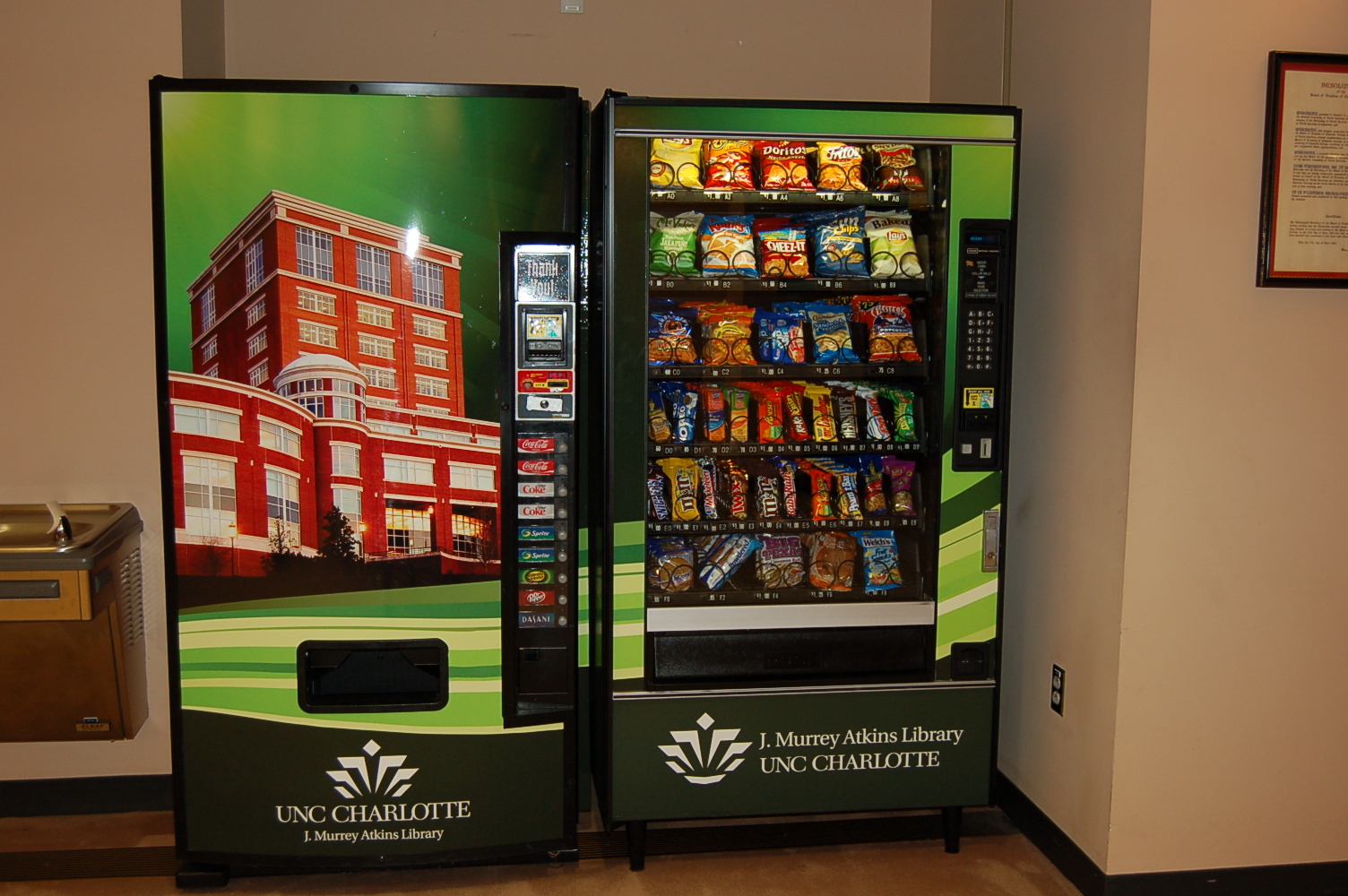
It is incorrect to say that there is a no-food, no-drink policy in the library.  In fact, we have vending  machines!

It was decided long ago that it was important for students to be able to stay in the library if they needed to keep their focus.  Bringing food with them, and taking a snack break before getting back into their studies allows for them to get more work done than if they had to go down to Peets, or even all the way down to the Prospector, Cone Center, or Student Union for a meal.  It’s not just about the time spent going to get food, but also about the loss of focus possible when you bump into friends on the way, chat about the weekend, and then oh wait where was I in this chapter….?

People persistently tell me that the library is a place for them to focus.  So of course, other people talking can be a problem if the way you focus is in absolute silence.  But many people use background noise as a way of gaining focus.  I’ve heard over and over, “if it’s too quiet, I can’t think.”  Of course, there are limits to how loud useful noise can be.  This struggle between quiet and reasonable noise is a constant one in university libraries, and we obviously have not come up with the perfect solution yet.  Some things we’ve tried so far include:
  • Designating the 3rd floor as a QZ.  I know (because many of you have told me!)  that there continue to be noise problems—some because of people who continue to use the 3rd floor as a study hall, even though it’s no longer the space for that.  Old traditions die hard.  We probably need to think about the furniture configurations up there, too. 
  • The floors in the Atkins tower now have wireless--so you can get away from it all, and still have access to the internet
  • There are more computers on each floor, especially on the third floor, so that there can be quiet computing space as well as constructively noisy computer spaces.
  • We've added more group study rooms, which are bookable online, and which provide spaces where you can either shut the door and study quietly, or shut the door and have group discussions.
  • The new group study areas on the ground floor, near the Library CafĂ©.  Having new spaces that encourage group study, we hope, will encourage people to leave the QZs quiet, because there are now better places to make constructive noise.
The editorial also covered sleeping in the library.  Speaking as someone who’s taken a fair share of library naps, I think this might be one of the things that we take on when we go to a 24-hour space.  People study at all hours of the night and day here now, and sometimes, they need to recharge—and can’t go all the way home to do so.  Until recently, people had to use two chairs to get a good nap space—unless they happened upon the One Library Couch.   
 
Now there are more couches, and more obvious chances to sleep.  As with eating, these are things that people do outside of the library, sure, but providing space for sleeping and eating (within reason) to happen in the library allow people to find focus and get their work done.

In short, while the editorial has good points, there is also an argument to be made for a variety of legitimate ways to use the library.  The tricky part is getting all of those different ways to use the library working in harmony with each other.  It’s a continuing challenge.  Please help by continuing with your feedback, and by working in Atkins!

Monday, November 29, 2010

Thanksgiving is over, but it's never too late to be Thankful

The Chronicle of Higher Ed's Thomas Benton has a column out listing the things he's grateful for in academe.  Libraries made the list, (I want to say, "of course"), and he's worth quoting in full, here:

Libraries and librarians: Our colleagues who are information professionals provide us with the scholarly resources we need for our research and teaching, and they do so with minimal recognition and considerable pressure to adapt to rapidly changing technologies. While the Internet has been a boon to scholarly research, the physical library is—more than stadiums, more than student centers—the heart of the academic enterprise: It's a place for solitary reflection as well as serendipitous encounters in the context of intellectual seriousness. Nothing can replace libraries as places, even if they are no longer primarily based on the circulation of printed materials.

What are you thankful for on campus?  Does the library make your list?

Monday, November 15, 2010

Thinking about how students do research

bear with me now, I'm going to start ugly with a reference to this article in the Chronicle of Higher Education.  In it, the "Shadow Scholar," a.k.a. a writer for a custom-paper mill, details his process, and justifies at length his participation in students' elaborate (and expensive) schemes to get degrees (not just bachelor's degrees, but M.As,  and even Ph.D.s) without doing the work.

His contempt for the education system as a whole is palpable.  That's not why I'm referring to this article here.  What struck me was his description of his "research" process:

"First I lay out the sections of an assignment—introduction, problem statement, methodology, literature review, findings, conclusion—whatever the instructions call for. Then I start Googling.

I haven't been to a library once since I started doing this job. Amazon is quite generous about free samples. If I can find a single page from a particular text, I can cobble that into a report, deducing what I don't know from customer reviews and publisher blurbs. Google Scholar is a great source for material, providing the abstract of nearly any journal article. And of course, there's Wikipedia, which is often my first stop when dealing with unfamiliar subjects. Naturally one must verify such material elsewhere, but I've taken hundreds of crash courses this way.


After I've gathered my sources, I pull out usable quotes, cite them, and distribute them among the sections of the assignment. Over the years, I've refined ways of stretching papers. I can write a four-word sentence in 40 words. Just give me one phrase of quotable text, and I'll produce two pages of ponderous explanation. I can say in 10 pages what most normal people could say in a paragraph."

This sounds terribly familiar.  I've been spending good chunks of this semester interviewing and observing students while they are doing their research, and the first stop for many is Google, the second stop, Wikipedia.  When they tell me they go to Wikipedia, they also tell me, "just for a start," and "I know professors don't like it, but I just want to get a sense for what is out there."  I suppose the technical term for what they are doing with Wikipedia is a browse, but they can also (and do also) browse on Google, and, for that matter, on the library's website.

Many of our student profess to never going into the library, either.  Or at least, to never using the library's resources.  "I can find everything I need online," is an oft-expressed sentiment.  When I ask what "online" means (because there's an awful lot from Atkins available online these days), they clarify:  "Google."  They get to articles via Google, they find books on Google books, and they also find (and use) information in a variety of websites (mostly .edu or .org sites, because many were taught at one point that the URL suffix can be one hint as to a website's reliability).

Some, but not all, students realize that the articles they get to via Google are actually available because of the Atkins library (that is, we pay for access, so that you can get to them).  Some, but not all students, realize that there are books in Atkins that could be helpful to them in the stacks.  Some, but not all students, are aware that websites are not ideal sources for research papers.

When professors insist, students seek out books.  When professors insist, students seek out peer-reviewed journal articles.  In the absence of that insistence--and sometimes, even in the presence of that insistence--students do the work that is expedient.  They find good-enough sources, and write good-enough papers.

When do students do better than "good enough?"  When they are working for a class they love, especially one in their major.  When they are the kind of student who will go onto graduate school, because they love the process of research.  When they are returning students, who have a very clear idea why they are at a university, and so want to get the best out of their experiences there.

If students are in a required class, a class they perceive to be a hoop they need to jump through to get to the next thing they would like to do, then they will do "good enough" work.

And if they don't see the point in doing the work at all, or if they are completely overwhelmed and don't know where to begin to start the work themselves, they might turn to someone like the "Shadow Scholar."
Monday, October 18, 2010

Chief Cultural Officer--the utility of anthropology to corporations

Universities are not Corporations (yet!), but do share aspects, in part because they are large organizations.  This is an interview tidbit on why it's important for corporations to be aware of the importance of culture>  I would argue that the same is largely true for Universities.

McCracken Interview

Thursday, September 30, 2010

Ground Floor Reconfigure

I'm sure you've noticed something different about the Ground Floor--new cafe name, furniture rearranged, carrels moving out.

Now it's REALLY different.  Check it out.


So, what will you do in this new space?
Will you do the same things?
Will you have to find another place to go?
Have you ever worked on the ground floor before?  Do you think you will, now?

Monday, September 13, 2010

Google Instant and psychic searching

Well the latest news about Google is that it's trying to predict what you are searching for instantly.  The results come up as you are still typing what you are looking for.  The early verdict is "clever, not psychic."  I wonder if it will turn into a kind of game--what is Google thinking I'm searching for?--very like when people allow their phones to complete the words they are typing, even (and especially) when it's the wrong words.

The impulse to know more than users do about what users are searching for can get us into trouble.  I'm not saying that users of library resources always know what is possible, when conducting a search.  But it is possible for  information specialists to go too far in assuming they think they know what people are looking for--or how they should be looking for it.  Information scientists are trained to organize information, and to retrieve it from information systems, but are not always working with systems that are intuitive to users.  Thinking that information science provides the best way to organize information can get in the way of library users finding the information they need--or even, perceiving the library as a good place they can go for resources.  If the organizing structures of the information resources are too challenging, people can give up. 

I wonder about Google Instant.  Will people respond well to Google presuming that it can know so much from so little initial data?  Will Google build in the right kind of flexibility. so that people can find what they are actually looking for, not just what Google thinks they are looking for?